The French and the river road to China
The Mekong Exploration Commission followed a hope of trade into southern China. At Khone Falls, the river itself showed where that hope ran aground.
- From Pakse
- About 3 hours by road
- At its best
- Any season
At Khone Falls, the Mekong’s long course meets a barrier that large boats cannot pass. The river rises on the Tibetan Plateau and runs more than 4,300 km to the South China Sea. A waterway of that scale looks, on a map, like a road waiting to be used. The falls and the other rapids made the hard part plain: a river can run a long way without carrying a boat all the way along it.
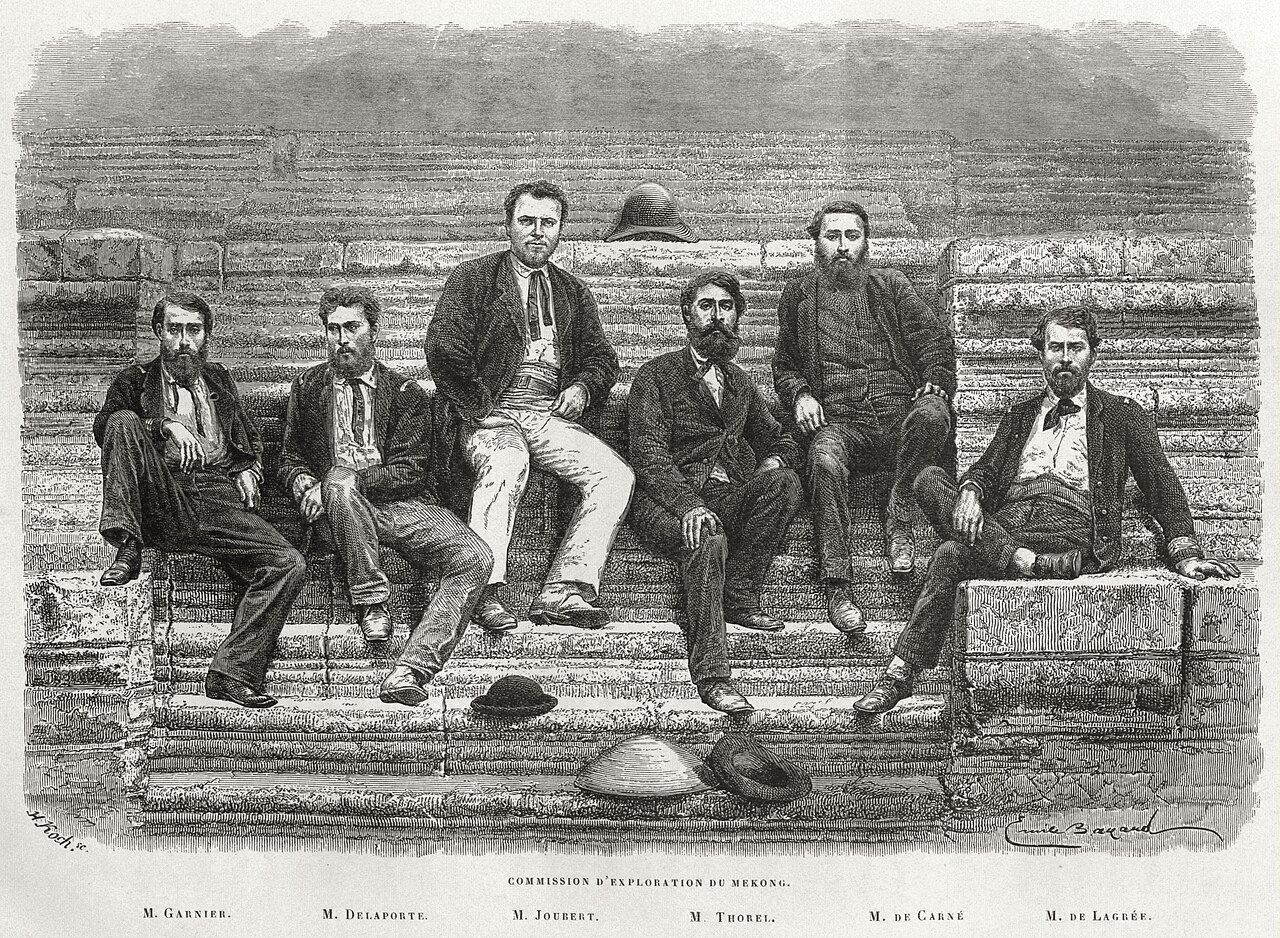
That was the question behind the French Mekong Exploration Commission. It travelled up the Mekong from 1866 to 1868, with the hope that the river could provide a trade route into southern China. The ambition was practical, not just a line drawn on a map. A navigable river would link the south to China by boat. But the route depended on a simple condition: large boats had to be able to travel the whole Mekong. The trade route was the point of going upriver; the rapids were not a side note, but the test the plan had to meet.
Ernest Doudart de Lagrée led the commission. The work was an attempt to understand whether the river could serve the trade plan, and the answer would be found in the river’s obstacles as much as in its length. That is the part worth keeping in view round here. The Mekong does not become a useful route just because it keeps flowing. Rapids are not a small inconvenience when the plan depends on boats passing through.
Doudart de Lagrée died in Yunnan in 1868. Francis Garnier took over the commission after his death. The change in leadership did not remove the central problem the expedition faced. The Mekong’s course still had its rapids, and the falls at Khone were still there. A river road to southern China had to work as a continuous route, not only across the easier stretches. On that point, the water offered no room for wishful thinking.
Khone Falls and the other rapids showed that large boats could not travel the whole Mekong. That is why the falls ended the hope of using the river as a through route to China. It was not a matter of the river being too short, or of the goal being unclear. The physical breaks in the route mattered more than the grand line on the map. Around here, the falls are the answer to the question the commission brought upriver.
The French later moved steamboats in pieces across the islands, so they could use them above the falls. A useful workaround, but not the original hope of an uninterrupted river road. Later, in 1893, the French took control of the territories east of the Mekong that became Laos. The river stayed central to the story, though its rapids had already made clear what it could not do for large boats. For another river story, follow the piece marked here.