Wat Phou: climbing the mountain temple
An uphill walk from the baray reservoirs to the sanctuary, reading the temple’s long history and its place beneath Phou Kao as the climb goes on.
- From Pakse
- About 1 hour by road
- At its best
- Cool season mornings
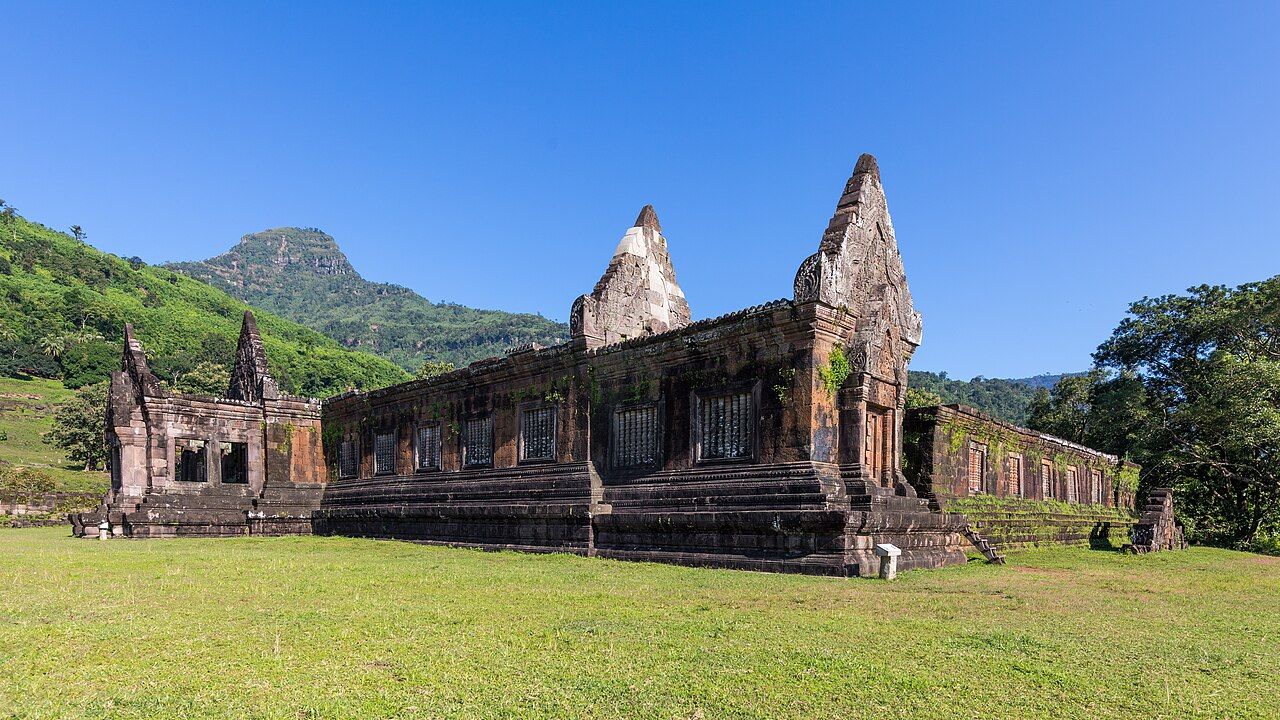
In the cool season morning, the route at Wat Phou starts low on the plain and rises towards Phou Kao. The ruined Khmer temple complex sits at the mountain’s foot, about 10 km south of Champasak town. From the baray reservoirs, a long processional causeway points uphill. The stair comes later, steep and made of stone. There is a lot to read in that change of scale: open ground first, then the temple buildings, then the hillside. The route itself gives the order.
Start with the causeway. It leads from the baray reservoirs past two large palace buildings. The long approach is part of the temple’s arrangement, not just a way to get from one point to another. Following it gives the lower part of the complex room to register before the climb begins. Wat Phou was first a Hindu temple dedicated to Shiva and later became a Buddhist site; the layers of worship belong to the place, rather than to a single moment in its history. A straight path towards the mountain, with the buildings alongside it. A fine introduction, and less demanding than the stair waiting above.
Keep Phou Kao in view. The mountain is not simply a backdrop to the temple. Its peak has a natural rock outcrop that was seen as a lingam, a symbol of Shiva. That connection helps explain why worship here reaches so far back: it dates to at least the 5th century. The surviving buildings mostly date from the 11th to 13th centuries, so the place holds a much longer span than the stonework alone suggests. It is worth letting those two scales sit together—the mountain and its sacred association, and the buildings people can still walk among. Round here, a good view often comes with a bit of history attached.
Notice the two palaces. They stand beside the processional causeway, on the route between the reservoirs and the hillside. Their position makes the approach feel deliberate. The temple is not a single sanctuary reached by the shortest possible line; it is a complex with a sequence, and the causeway lays that sequence out plainly. Most of the structures still standing belong to the 11th to 13th centuries, but worship at Wat Phou began centuries earlier. The lower ground deserves time before the steep part. The walk is better understood as a whole, though the stair does have a way of taking over the conversation.
Take the steep stone stair. It climbs the hillside to the main sanctuary, and the change is immediate: the route turns from a long approach into an uphill effort. The stair is the part that makes the landscape come into view in pieces. That is my favourite way to read Wat Phou. The mountain stays close, the lower complex recedes, and the temple’s position on the slope becomes clearer as the climb continues. Cool season mornings suit this walk. The stair is still steep; the season does not negotiate that point. But the climb gives the site its shape, and the effort belongs to the experience rather than being a detour from it.
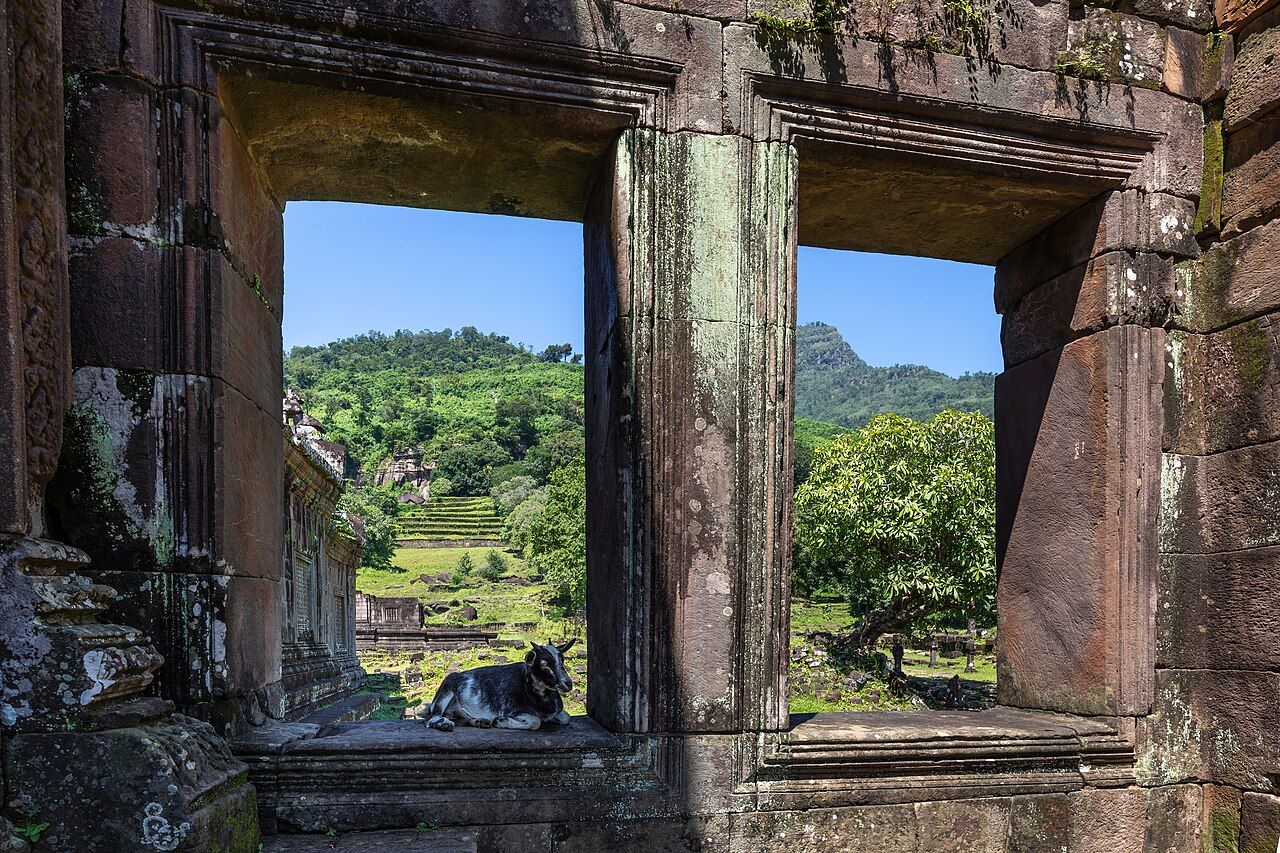

The stair is the part that makes the landscape come into view in pieces.
Pause at the sanctuary. The main sanctuary sits above the long route and the steep stair. Behind it, a sacred spring flows from the cliff. The water is part of the place’s meaning, not an extra feature added to the walk. Wat Phou began as a Hindu temple dedicated to Shiva and later became a Buddhist site, and that history is present in the way the sacred landscape and the built complex meet. Here, the cliff, spring and sanctuary belong in the same view. The nicest thing about reaching the top is not simply having finished the climb. It is seeing how the parts below lead to this one.
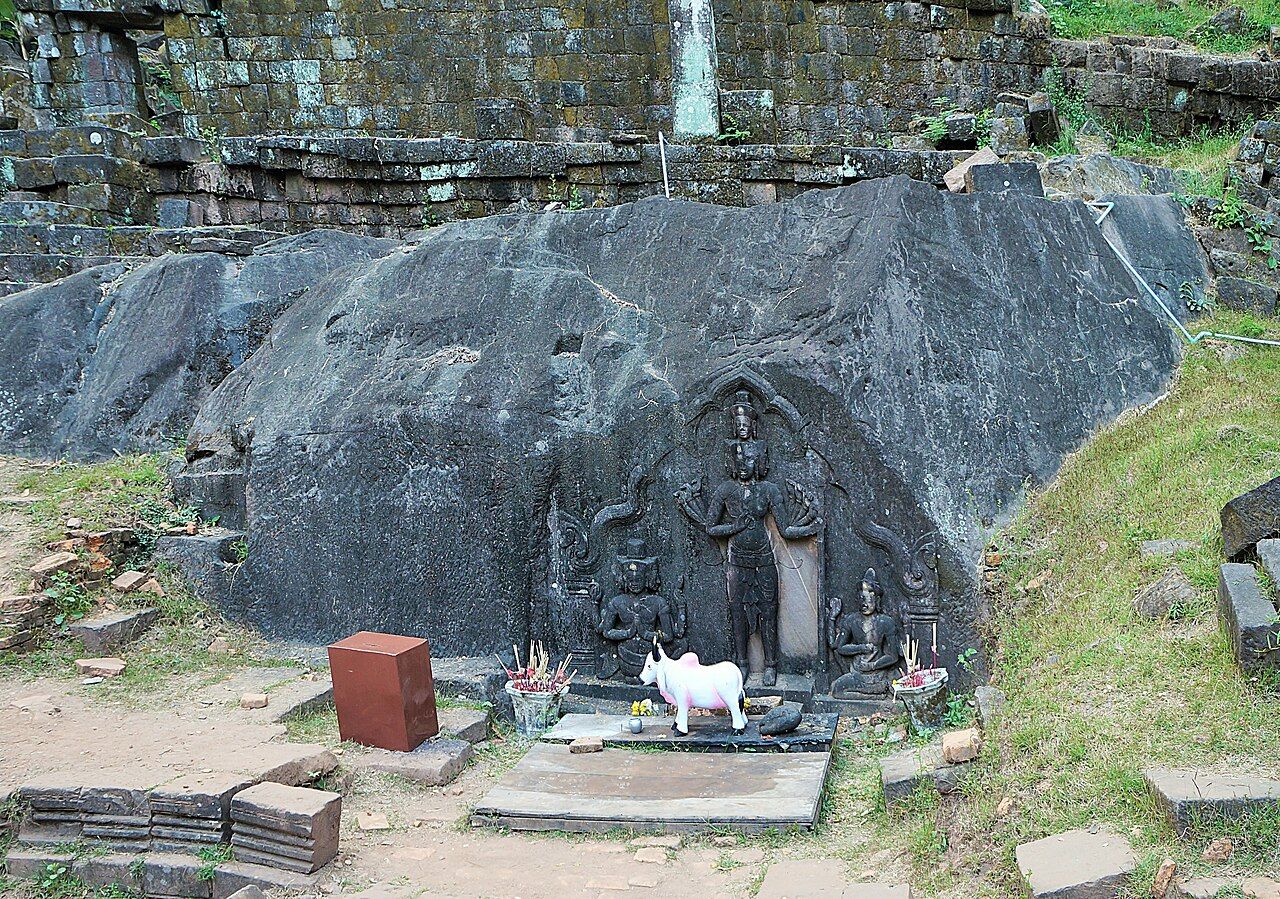
Look for the carvings. Near the upper terrace, an elephant and a crocodile are cut into boulders. They are easy to treat as small details after the causeway and stair have set the scale of the visit, but they reward a slower look. The upper terrace brings together the carved stone, the sanctuary and the spring behind it. The site does not need grand claims to hold attention; its details do the work. There is also an ancient road that once linked Wat Phou with Angkor in present-day Cambodia. That connection places the complex within a wider history, while the carvings keep the attention close to the stone underfoot.
Read the plain as well as the slope. The ancient city of Shrestapura lies on the plain near the Mekong, east of Wat Phou. The temple and the old city are part of the larger cultural landscape, not isolated points on a mountain. UNESCO inscribed the Vat Phou and Associated Ancient Settlements within the Champasak Cultural Landscape on the World Heritage List in 2001. That formal name is a reminder to look beyond the sanctuary: the setting includes the plain, the Mekong and the old route between places. Wat Phou is about 1 hour by road from Pakse. From Champasak town, it is about 10 km south. The map earns its keep after all.
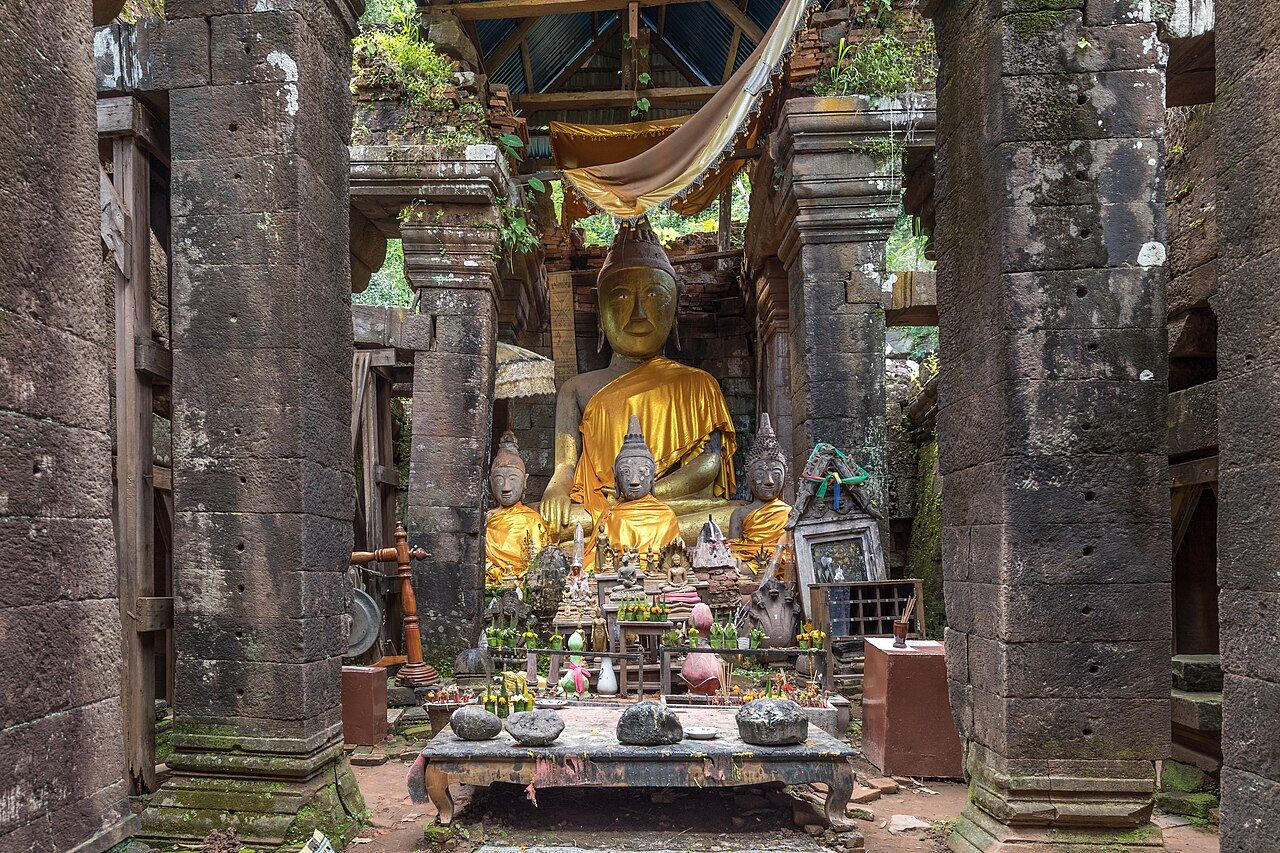

The the February full-moon gathering belongs to the living story of Wat Phou, alongside its long temple history.

For another story from this part of the region, continue with Champasak town.